


Home page >> Product display >> Stress corrosion testing machine >> MYLH-100H Metal Materials Hydrogen Environmental Compatibility Testing Machine
Equipment introduction
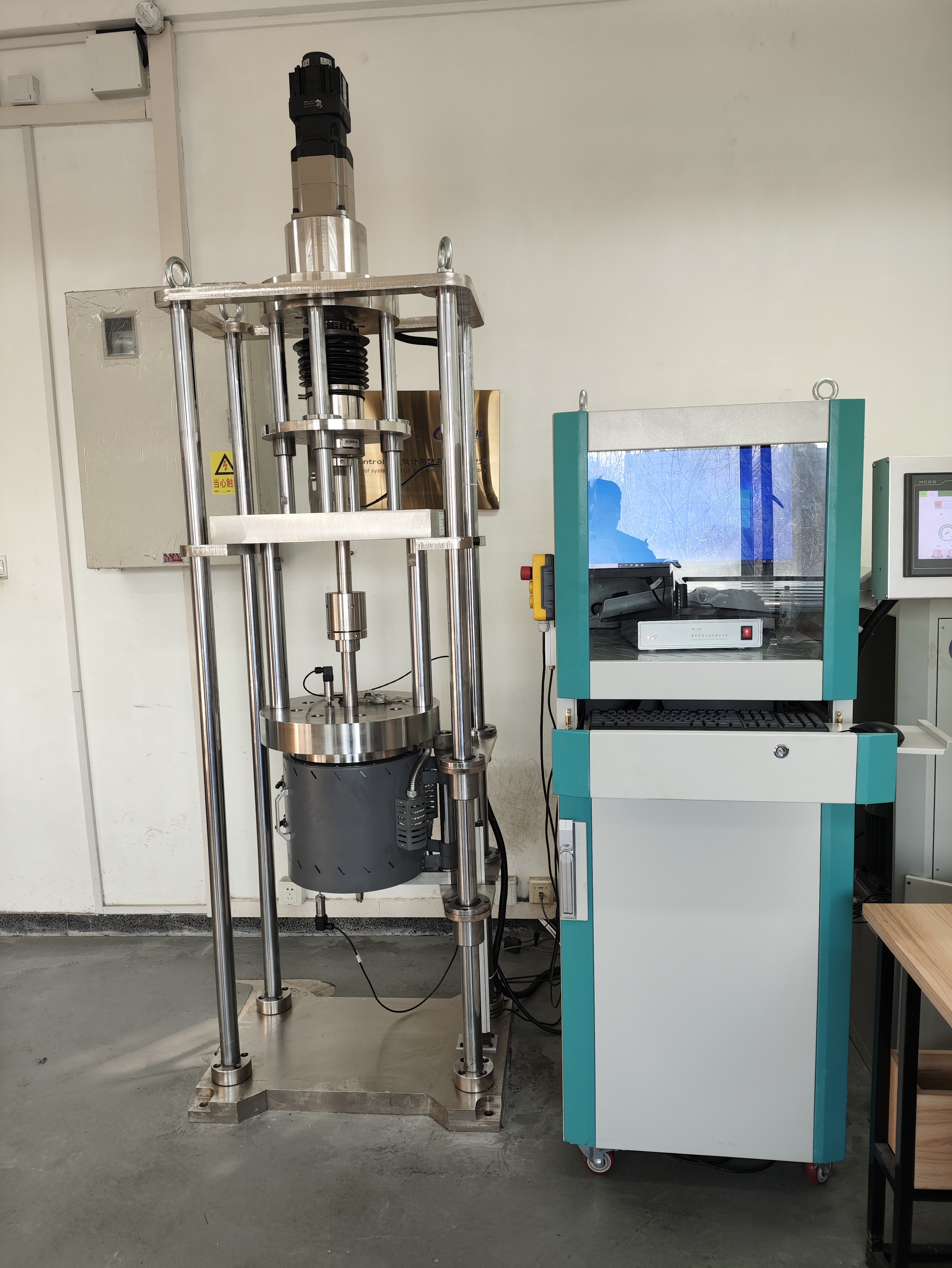
The metal material hydrogen environment compatibility testing machine is mainly used for slow strain rate (SSRT) stress corrosion (SCC) testing, fatigue testing, etc. of metal materials in a hydrogen environment.Depending on the configuration, tests related to dynamic fracture mechanics can also be performed.
This series of equipment adopts a frame-type host structure and generally consists of an independent loading unit, a hydrogen high-pressure test kettle, a fixture, a control system, a deformation system, measurement and control software, a hydrogen gas boosting system, a temperature control system, a detection and alarm system, etc.
The loading unit can be flexibly installed at the upper or lower end according to test requirements to adapt to the test requirements of different media environments.Depending on the accessories, this series of equipment can be used in a variety of test environments, including various extreme conditions, such as low temperature (up to -55°C), high pressure (up to 140MPa), or other ultra-low temperature liquid hydrogen corrosive media environments.
In addition to the main equipment, this series of stress corrosion testing machines also has a variety of optional units to achieve expanded functions beyond the basic testing functions.
Test function in hydrogen environment(Determined according to the specific order supply scope)
1) Tensile test with ordinary electronic universal testing machine;
2) Constant load creep/stress corrosion test;
3) Slow strain rate tensile test;
4) CT specimen crack growth test;
5) Low cycle fatigue test;
6) Remote automatic control of the gas circuit, capable of pressurizing, depressurizing, and maintaining pressure;
5Main technical parameters
1) Maximum test force: 50kN/100kN
2) Test force range: 1%~100%F.S.
3) Relative error of test force indication: ±0.5%
4) Maximum moving range of loading head: 80mm
5) Minimum loading strain rate: 1x10⁻⁷/s
6) Maximum moving speed of loading head: 10mm/s
7) Loading frequency: (0.1-1) Hz
8) Loading head displacement measurement accuracy: ±0.5%
9) Loading head displacement resolution: 0.012µm
10) Deformation measurement range: 0~30mm
11) Deformation measurement resolution: 1µm
12) Deformation measurement accuracy: ±0.5%
13) Test temperature: (-55~100)℃
14) Experimental kettle volume: about 8L (can be customized according to actual needs)
15) Balance device stroke: 60mm;
16) Maximum working pressure: 140Mpa;
17) Direct measurement of the axial deformation and crack length of the sample in a high-pressure hydrogen environment does not allow indirect measurement outside the kettle;
18) Medium: Hydrogen