



Home page >> Product display >> Stress corrosion testing machine >> Sodium chloride/magnesium chloride medium slow strain rate stress corrosion testing machine
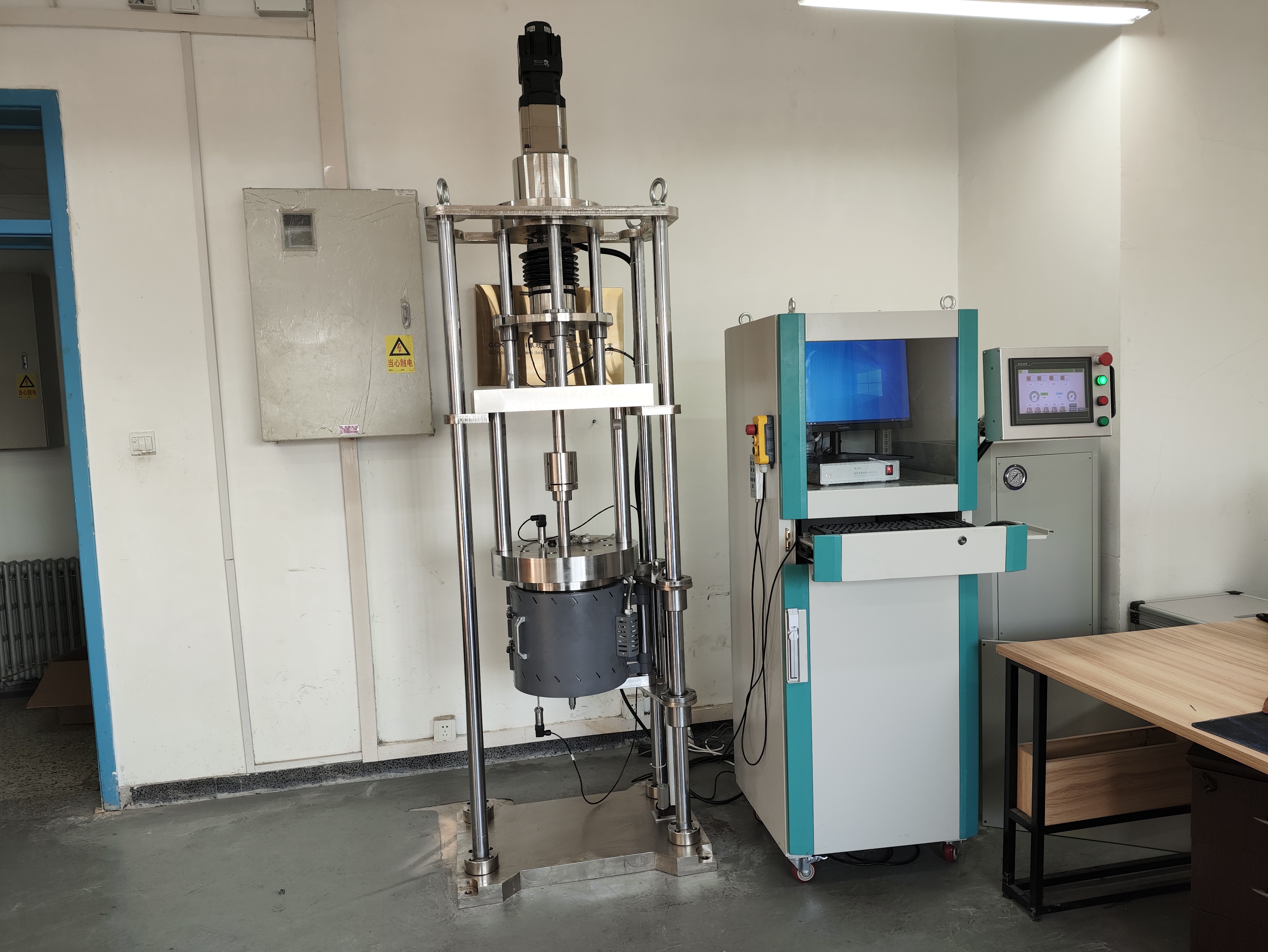
1. Equipment introduction
Slow strain rate (SSRT) stress corrosion (SCC) testing machines are used to perform corrosion tensile testing of materials in corrosive environments.
This equipment is a special slow strain rate stress corrosion testing machine for high-temperature magnesium chloride and sodium chloride solutions. It adopts an external structure with a tensile clamp. The applicable environment is normal pressure, normal temperature, and high temperature (not greater than 155°C).
Relevant test standards:
1) ASTM G129 - 00(2006) Standard Practice for Slow Strain Rate Testing to Evaluate the Susceptibility of Metallic Materials to Environmentally Assisted Cracking
2) ISO 7539-7-2005 Corrosion of metals and alloys – Stress corrosion testing Part7: Method for slow strain rate testing
3) YB/T5362-2006 Test method for stress corrosion of stainless steel in boiling magnesium chloride solution
4) HB 7235-1995 Slow strain rate stress corrosion test method
5) HB 5260-1983 Tensile stress corrosion test method for martensitic stainless steel
6) GB/T15970.7 "Corrosion of Metals and Alloys - Stress Corrosion Testing Part 7: Slow Strain Rate Test"
2. Test function
1) It has the tensile testing function of an ordinary electronic universal testing machine.
2) Constant load creep/stress corrosion test.
3) Slow strain rate tensile test, minimum crosshead moving speed: 1x10⁻⁷mm/s.
3. Test software functions
1) Supports metric units and imperial units;
2) Support function navigation, select the corresponding test function according to the navigation interface;
3) Real-time display of force, displacement and deformation values
4) Draw force-displacement curve, force-strain curve, force-time curve, strain-time curve, stress-strain curve, etc. in real time;
5) Support the process design of sample control to facilitate the expansion of test methods;
6) Support slow strain loading control;
7) Support real-time measurement of environmental system data such as temperature;
8) Support automatic and manual test log recording;
9) Support function recovery after test suspension;
10) Support test recovery function after power failure;
11) Support collection data retention after power failure;
12) Support long-term continuous testing of more than 30 days;
13) Test data can be exported to EXCEL and ACCESS formats;
14) Support equipment overload protection and various equipment safety and test safety protections.
4. Technical parameters
1) Maximum test force: 50kN, 100kN
2) Test force range: 1%~100%F.S.
3) Relative error of test force indication: ±0.5%
4) Maximum moving range of loading head: 80mm
5) Loading head moving speed: 1mm/s~1x10-7mm/s
6) Loading head displacement measurement accuracy: ±0.5%
7) Loading head displacement resolution: 0.0125µm
8) Sample deformation range: 0~10mm
9) Deformation measurement range: 0~30mm
10) Deformation measurement resolution: 1µm
11) Deformation measurement accuracy: ±0.5%
12) Test temperature: normal temperature ~550℃
13) Temperature control accuracy: ≤±1℃
14) Experimental kettle volume: about 500ml