


Home page >> Product display >> Stress corrosion testing machine >> Molten Salt Medium Slow Strain Rate Stress Corrosion Testing Machine
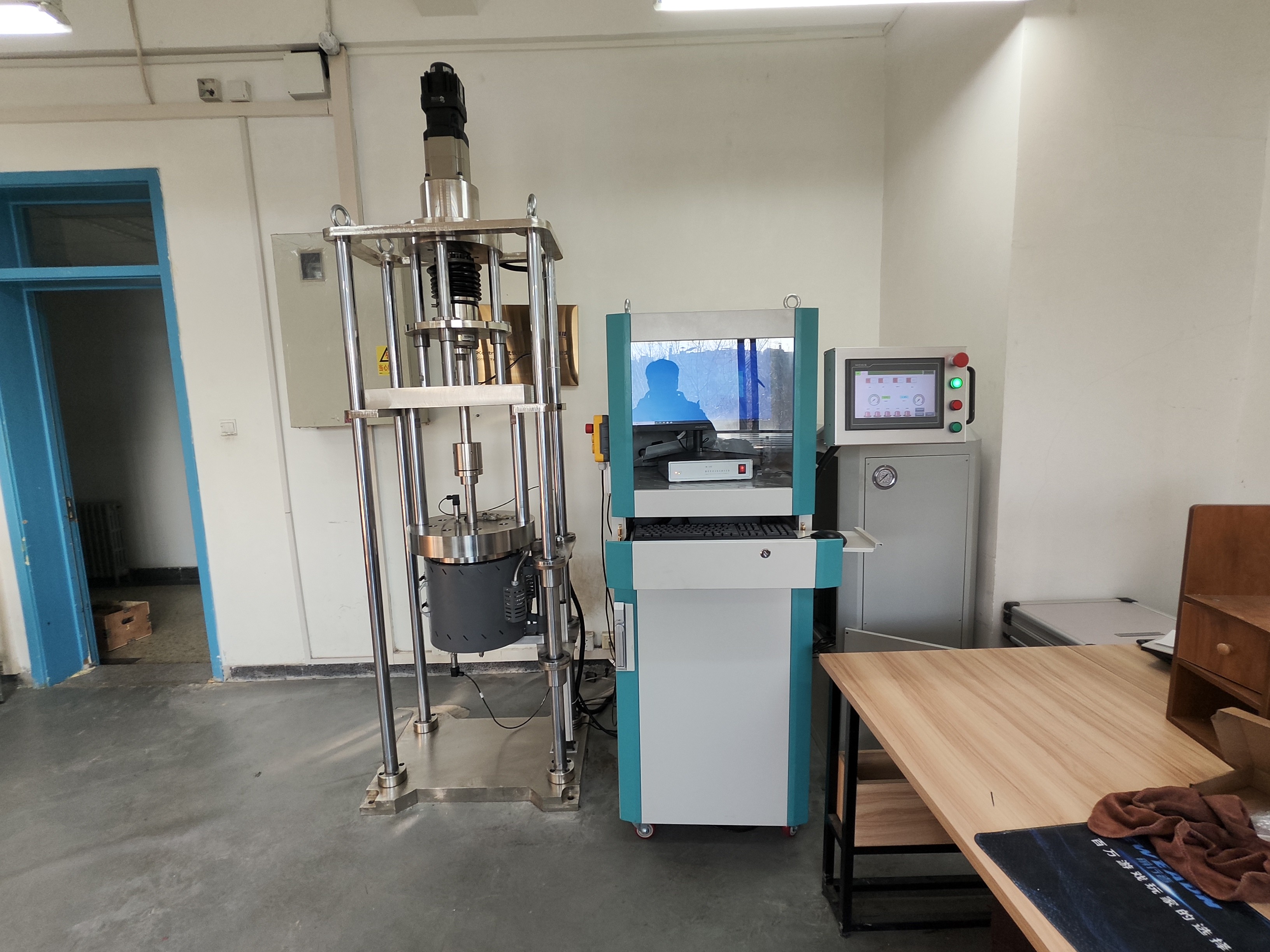
Equipment brief description:
This equipment is used to test the corrosion resistance of materials in fluorine salt media environments.
The equipment consists of a load-bearing frame, a loading unit, a control system, a melting kettle, an experimental kettle, a heating system, a gas path control system, a DCPD crack growth measurement system, and test software.
The experimental kettle and high-temperature furnace can be lifted and lowered electrically to facilitate the installation of specimens.In addition to the basic functions of vacuuming and argon injection, the gas control system also has the functions of setting and maintaining the atmosphere pressure of the experimental kettle.
The lid of the experimental kettle has interfaces for vacuuming, argon gas injection, salt injection, salt discharge, temperature measurement, liquid level measurement, DCPD measurement, etc.
By adding corresponding configurations, the slow strain rate stress corrosion testing machine can realize many functions: it can perform slow strain rate tensile test (SSRT), constant load stress corrosion cracking (SCC) test, corrosion fatigue (CF) test, creep (Creep) test, creep fatigue (Creep Fatigue) test, strain fatigue (Strain Fatigue) test, and lasting strength (Creep Rupture Strength).Test, hydrogen-induced delayed cracking (HIC) test, stress corrosion cracking (SCC) crack growth measurement, corrosion fatigue crack growth measurement and other tests.
Experimental features:
Ordinary tensile test.
Constant load creep/stress corrosion testing.
Slow strain rate tensile testing.
Low cycle fatigue/corrosion fatigue testing.
Test for measuring crack initiation and crack propagation rate of specimens.
Constant K control, rising K control, and falling K control tests.
Features:
Dynamic display: Load, displacement, deformation, time and test curves are dynamically displayed on the screen in real time.
Record and output stress-strain, force-time, force-displacement and other test data and curves.
Supports long-term continuous testing.
The test control is streamlined and the test process conditions can be compiled by oneself.
Automatic protection: Automatic protection and memory when force value reaches, time limit, breakage, etc. occur.
Automatic data processing: The test software automatically processes data according to corresponding standards.
Data is saved at any time and retained when power is turned off.
The test results can be stored and can be read and consulted at any time.
Test data and curves can be reanalyzed, and curves can be enlarged arbitrarily.
The open test report supports customized report templates, automatically generates test reports, can be printed or previewed, and can be saved as a file.
It has software limit protection, stroke limit protection, and full-scale overload protection functions.
Equipment features:
High rigidity heavy load frame.
High-performance fully digital servo loading control system with high speed control accuracy.
Using grating displacement sensor, the sample deformation measurement accuracy is high.
Integrated measurement and control system facilitates expansion and use.
Realize crack growth measurement in corrosive media environment.
Technical indicators:
| Product model | HYMYL-50 |
| Maximum test force | 50kN |
| Test force measurement range | 1%~100%F.S. |
| Test force indication accuracy | ±0.5% |
| Test force resolution | ±180000 codes, no binning throughout, resolution remains unchanged |
| Loading head movement range | 80mm |
| Loading head movement speed | 10mm/s~1x10-7mm/s |
| Loading head displacement indication accuracy | ±0.5% |
| Loading head displacement resolution | 0.05µm |
| Deformation measurement range | 0~30mm |
| Deformation indication accuracy | ±0.5% |
| Deformation resolution | 0.001mm |
| Fatigue loading waveform | Sine wave, triangle wave |
| Fatigue loading frequency | 0.0001~1Hz |
| Crack measurement length resolution | 1µm |
| Heating furnace temperature range | <1000℃ |
| Experimental kettle working temperature | ≤750℃ |
| Vacuum degree | 1×10⁻²torr |
| Vacuum leak rate | 1×10⁻⁵Pa·m3/s |
| Maximum work pressure | 0.3MPa |