


Home page >> Product display >> Stress corrosion testing machine >> Nuclear power ultra-high temperature and high pressure supercritical water medium slow strain rate stress corrosion testing machine
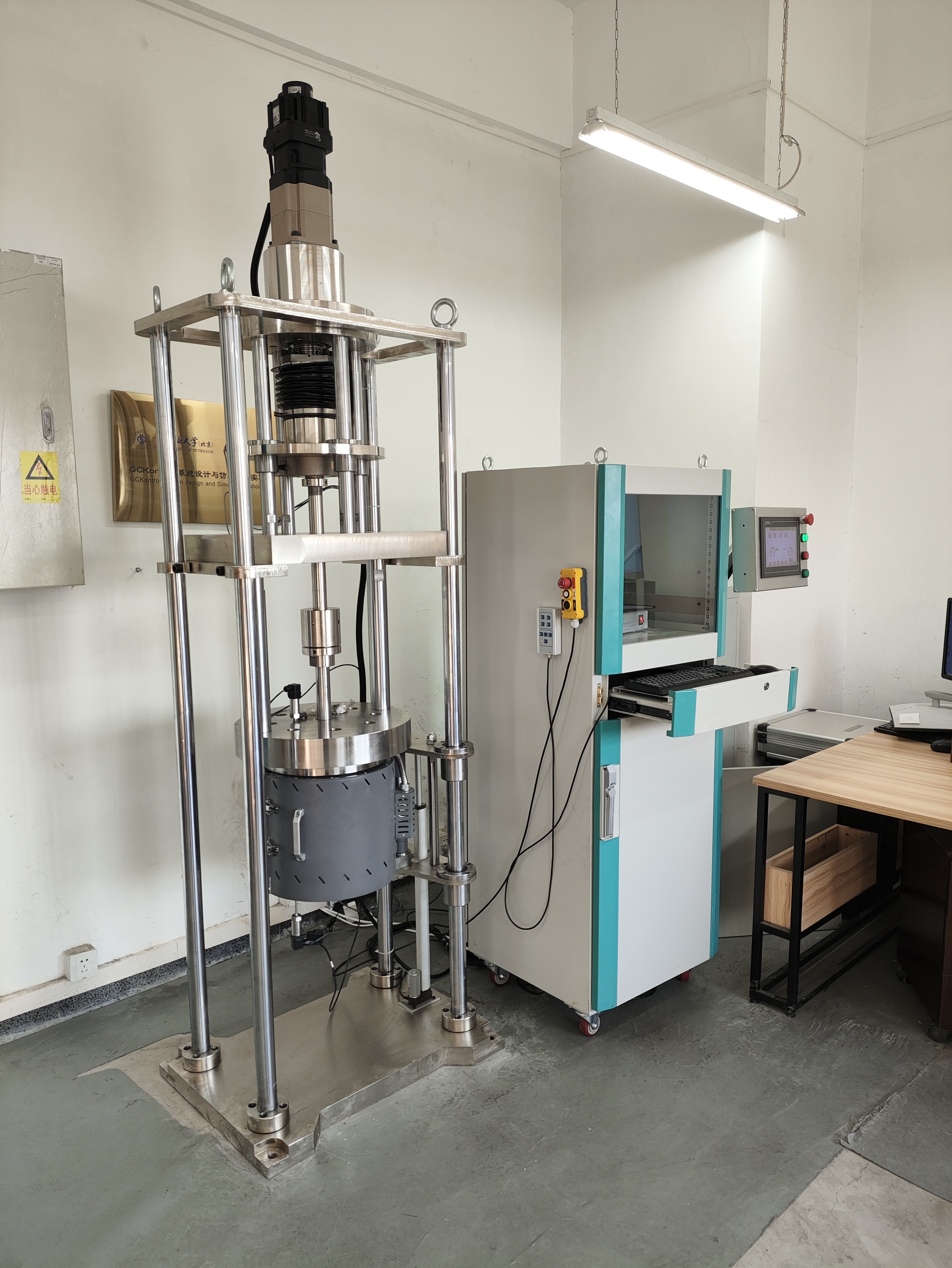
1. Brief description of equipment
Slow strain rate (SSRT) stress corrosion (SCC) testing machines are used to perform corrosion tensile testing of materials in corrosive environments.
The experimental kettle provides test conditions in a medium environment, realizing test environments from normal temperature to high temperature, and from normal pressure to high pressure.When the concentration of some media reaches a certain ppm value, the service life of the experimental kettle system needs to be considered.
Configuring the DCPD crack growth measurement system and replacing it with a loading unit for fatigue testing can achieve corrosion fatigue loading and continuous crack growth length and crack growth rate measurement in corrosive environments.
2. System composition
This test system consists of a tensile loading system, a corrosion environment container (experimental kettle), a solution environment chemical measurement and control system, a test fixture, a measurement and control system, test software, a computer, and a control cabinet.This product is equipped with a DCPD crack measurement system.
3. Equipment characteristics
1) High rigidity and heavy load frame;
2) High-performance all-digital servo loading control system with high speed control accuracy;
3) Dual strain sensors enable accurate measurement of sample deformation;
4) Pressure balancing device;
5) Integrated measurement and control system, easy to expand and use;
6) Able to measure crack growth in corrosive media environments.
4. Test function
1) It has the tensile testing function of an ordinary electronic universal testing machine.
2) Constant load creep/stress corrosion test.
3) Slow strain rate tensile test, minimum tensile speed: 1x10⁻⁶mm/s.
4) Low cycle fatigue/corrosion fatigue test.
5) Strain zero-crossing fatigue test.
6) Measurement test of sample crack initiation and crack growth rate.
7) Constant K control test, rising K control test, and falling K control test can be performed.
5. Technical parameters
1) Maximum test force: 50kN
2) Test force range: 1%~100%F.S.
3) Relative error of test force indication: ±0.5%
4) Maximum moving range of loading head: 80mm
5) Loading head moving speed: 10mm/s~1x10-6mm/s
6) Loading head displacement measurement accuracy: ±0.5%
7) Loading head displacement resolution: 0.05µm
8) Deformation measurement range: 0~12.7mm
9) Deformation measurement resolution: 0.1µm
10) Deformation measurement accuracy: ±0.5%
11) Fatigue loading waveforms: sine wave, triangle wave, and half wave
12) Fatigue loading sine wave frequency: 0.001~1Hz
13) Crack measurement length resolution: up to 1µm
14) Experimental kettle operating temperature: normal temperature ~ 650℃
15) Maximum operating pressure of experimental kettle: 30MPa
16) Experimental kettle volume: not less than 3L
17) Water circuit system pressure capacity: 30MPa
18) Gas circuit system pressure capacity: 10MPa